Enhancing Your Self-Esteem
Self-esteem can be described as how we view ourselves. A person’s overall sense of worth and the value that we place on ourselves. It is more than simply liking oneself but being able to stand in the affirmative that you have a right to be happy and to live a satisfying and fulfilling life. People can have either positive or high self-esteem or negative or low self-esteem. People with low self-esteem suffer from self-doubt, people pleasing and feelings of unworthiness. Self-esteem can be influenced by how we think which can then influence how we feel about ourselves. People experience high self-esteem when they receive positive feedback from others and are respected by others. People experience low self-esteem when they feel unworthy or are viewed negatively by others. I invite you to challenge your negative self-beliefs, try a gentler approach and show more self-compassion and find ways to develop a healthy assertive style of communication.
Self-esteem is influenced by various factors. How we self-evaluate is an indication of self-esteem as well as how we view our own performance. Another factor that influences self-esteem is how we evaluate our relationships with others. Self-esteem can be stable over time, either high or low throughout the years or change on a day-to-day basis depending on our interactions with other people and events that take place and how we respond to them and manage or adapt.
It would be fair to say that people can develop a different set of skills that can improve their self-esteem. For example, being able to cope with and deal with disappointments or setbacks in life can lead to increased feelings of well-being and self-esteem. Have you ever noticed how some people seem to bounce back from setbacks and disappointments well while others are unable to do so. I call this the rubber band effect. They are flexible, highly adaptable and are able to move forward and to move on. When people think or feel that they can overcome obstacles either alone or with some hurdle help, they feel more successful thus increasing or enhancing their self-esteem. When people feel that they can’t get through a roadblock or obstacle or don’t feel supported in any way, their self-esteem suffers. They feel incapable, negative and criticized and this leads to negative self-esteem.
Some people are incredibly resilient and are unaffected by the views of others and therefore manage to preserve their self-esteem and keep it stable over time. Other people are very influenced by others' views and have a hard time setting boundaries with others and are like a sponge, absorbing everyone’s opinions or views about them. This can wreak havoc on a person’s self-esteem. There is a saying that goes - People would care less what others think of them when and if they realized how little others think of them- Focusing too much on what others think of you is referred to as the Spotlight Effect. This is the practice of overestimating how much other people actually think of you and your actions. This piece of information should help to improve self-esteem for those of you who are often concerned about what other people may think of you.
To give you an idea of where your self-esteem lies, please feel free to self-evaluate using the following scale by Rosenberg:
To score the items, assign a value to each of the 10 items as follows:
• For items 1,2,4,6,7: Strongly Agree=3, Agree=2, Disagree=1, and Strongly Disagree=0.
• For items 3,5,8,9,10 (which are reversed in valence and noted with the asterisks** below): Strongly Agree=0, Agree=1, Disagree=2, and Strongly Disagree=3.
BELOW IS A LIST OF STATEMENTS DEALING WITH YOUR GENERAL FEELINGS ABOUT YOURSELF. IF YOU STRONGLY AGREE, CIRCLE SA. IF YOU AGREE WITH THE STATEMENT, CIRCLE A. IF YOU DISAGREE, CIRCLE D. IF YOU STRONGLY DISAGREE, CIRCLE SD.
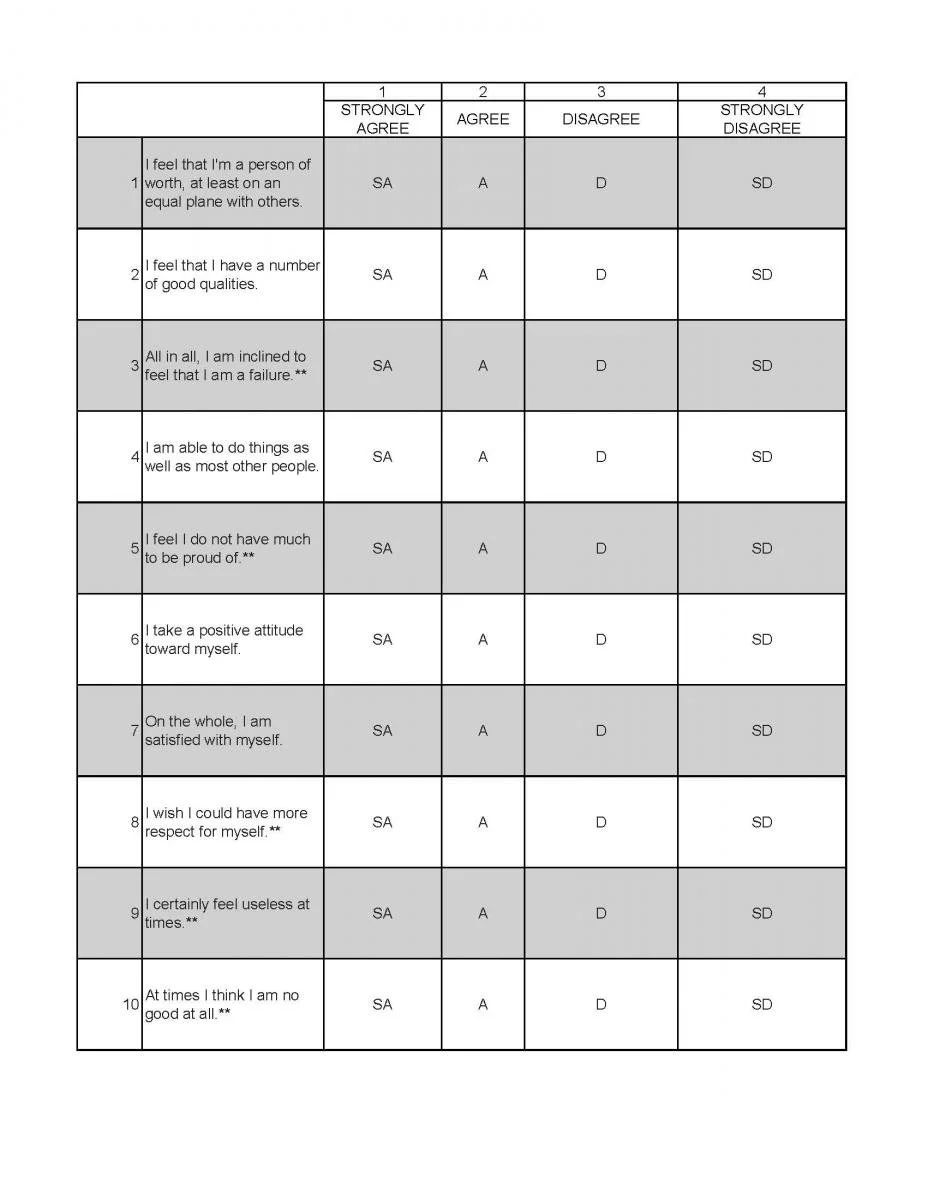
*Please note that this evaluation is a tool and a point of reference and is not a diagnostic tool. The following is an interpretation of the score:
The scale ranges from 0-30. A score between 30 and 40 suggests high self-esteem. A score between 15-25 is considered a normal range. Scores below 15 suggest low self-esteem.
According to research (Sinclair et al, 2010), the average self-esteem score was 22.62
The following is designed to help you enhance your feelings of self-worth and self-esteem:
-- Develop the skills in the area or hobby that interests you. Individuals who feel that they have the know-how or tools feel more successful and better about themselves and this improves their overall self-esteem. Take a cooking class, learn to play a musical instrument you always wanted to learn. Make it fun and realistic. You are not aiming for perfection.
-- Build relationships and connections with others. Human beings are social beings and having and maintaining healthy fulfilling relationships leads to feeling better about yourself overall. Find the way that works for you. Some people use social media; others prefer in person activities. For others it’s attending a church group.
-- Try to set realistic expectations for yourself and focus on your strengths and not your weaknesses. Learn to respect your limits and learn that it’s ok to say no. Celebrate the moments that go well, and this will more than likely lead to more positive experiences.
--Surround yourself with positive supportive people. Set boundaries where necessary and practice asserting your needs. People that feel supported enjoy a higher sense of self-esteem. Your support circle is vital. Limit interactions with negative people that drain your energy. If you are a caregiver, practice empathy, but remember to take care of yourself. You can’t pour from an empty cup.
--Take care of your physical needs. Try to get some exercise at least 3 times a week for a minimum of 30 minutes. In an article I read recently, walking was the one activity more popular than any other activity to help people be at their best, more than any other physical activity.
--Do prioritize your sleep. Getting a good night’s rest is not optional. It most definitely influences your overall mood and well-being. Turn off the distractions. Play a relaxing CD. Put it on repeat.
--Practice mindfulness. This could be a simple 10 minute a day guided meditation or, recently popular, a walking meditation. Try meditations with more guidance and less guidance and find the one that works for you. Try chanting a self- affirming mantra.
--Avoid comparing yourself to others. Focus on your own strengths and gifts and develop them. When the destructive habit of comparison starts to emerge, meditate, exercise, read your affirmations, give it a rest.
--Be kinder to yourself. Practice self-compassion and try a gentler approach which is linked to high self-esteem and feelings of self-worth.
--Practice self-acceptance. We can’t change what we don’t accept, whether it’s with ourselves or with other people we have relationships with. Self-acceptance leads to enhanced feelings of self-esteem.

Assertiveness is Linked to High Self- Esteem
Characteristics of Assertive People:
--They value open–mindedness. Assertive people are able to respect the different viewpoints of others.
--Assertive people are able to listen actively to another person, asking for clarification when necessary.
--They continue evolving and learning through this process. It is possible to be wrong at times and sometimes necessary to change your point of view.
--Become aware of the difference between being assertive and being aggressive. Adjust as necessary. Also become aware of your body language and physical distance to the other person.
--Make use of “I” statements. Avoid placing the blame on others. You will feel empowered and more self-confident.
--Practice clear communication. Do not assume the other person automatically knows what you’re thinking or feeling.
--When confused or if something is unclear, ask for clarification. Your self-confidence will improve as you become more comfortable practicing these skills.